
Most of what I write tells you to trust the framework at the exact moment you least want to. Hold when it says hold. Trim when the trim hurts. The entire point of a rules-based system is that it overrides your mood, and your mood is usually the thing that needs overriding.
This one runs the other way. There are rare situations — a handful per decade, not per year — where a risk reading is less trustworthy than usual. Not because the logic broke. Because the inputs feeding it were temporarily distorted, and the framework has no way to tell you so.
That is what I mean by the phrase. When the framework lies, it is not lying about its own reasoning. It is reporting a corrupted number with total confidence, because confidence is the only register it has. It cannot say “I am less sure this week.” You have to say that for it.
Knowing where this happens is not an argument for abandoning the system. It is the opposite. The people who blow up with a framework are the ones who treat it as infallible and then get blindsided the one time it is not. The people who last are the ones who know exactly which conditions make their tools unreliable, and size down when they are standing in one.
Educational content only. Not financial advice.
What “when the framework lies” does not mean
Let me close the escape hatch before anyone walks through it.
It does not mean the framework gave a reading you disagreed with and the market later went your way. That is not distortion. That is wanting permission to override the system and finding a technical-sounding label for it. The feeling of knowing better than the reading is the single most expensive feeling in investing, and it is almost always wrong. What that override actually feels like from the inside, in the minutes before it happens, is written out in the trade I almost made.
It also does not mean the framework was early. The ladders are supposed to be early. A reading that says elevated risk while the price keeps climbing is not lying. It is doing its job, describing a stretched market while the crowd is still euphoric. Being early and being wrong look identical for a while, and then they stop looking identical, usually abruptly.
Input distortion is narrower and more technical than either. It is when one of the underlying signals is temporarily measuring something other than what it was built to measure, so the composite reading rests on a corrupted number. The logic is intact. The feed is not.
The inputs are proxies, and proxies can detach
To see how an input gets distorted you have to remember what an input is doing in the first place. A risk-first framework reads a small set of signals — price extension, sentiment, an underlying-signal layer, and macro conditions — and combines them into one composite reading per asset.
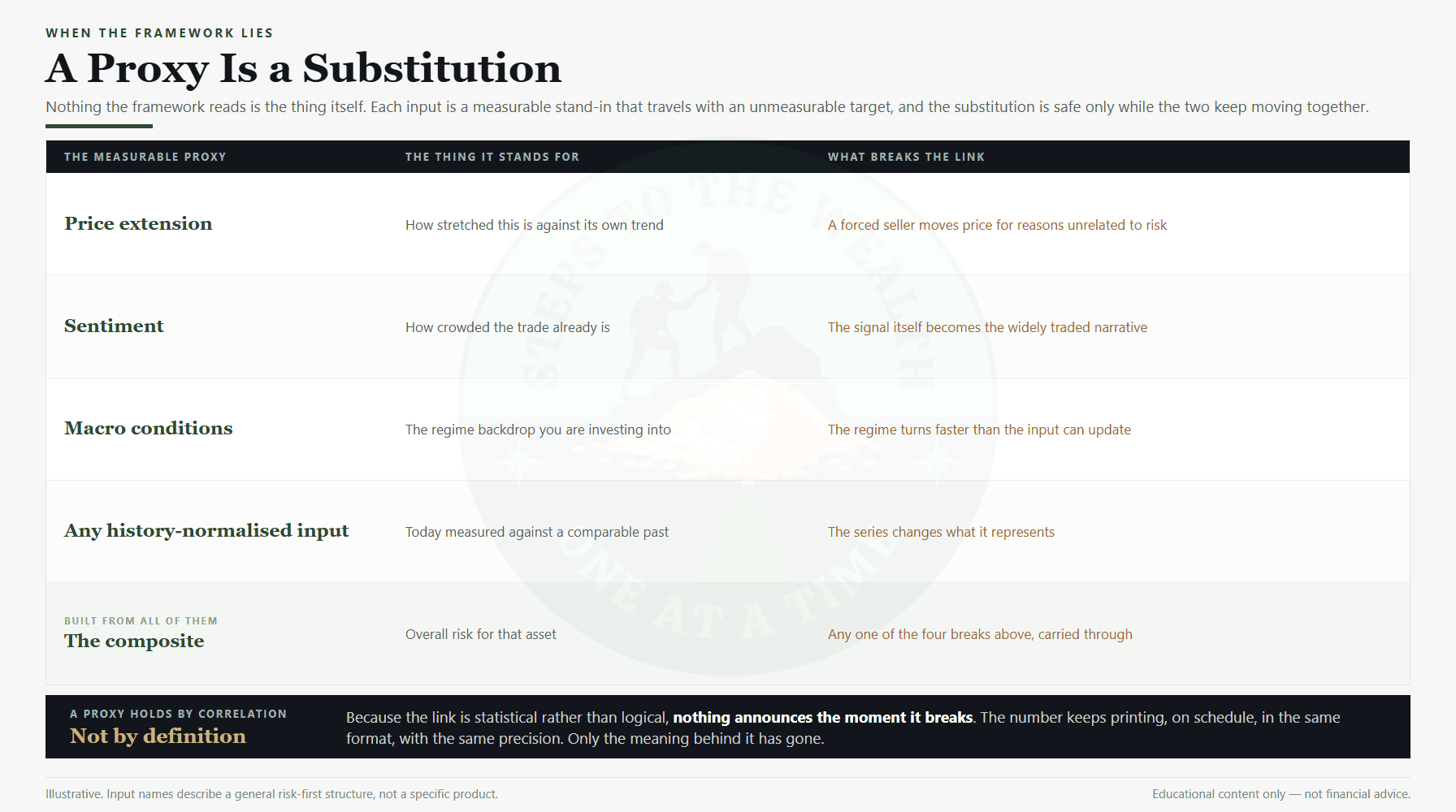
Every one of those is a proxy. Price extension is a proxy for how stretched something is relative to its own trend. Sentiment is a proxy for how crowded the trade is. Macro is a proxy for the regime backdrop. None of them measures the real thing directly, because the real thing is not measurable. They measure something that moves with it.
A proxy works because that correlation holds most of the time. Stretchedness is not observable; price extension is, and the two travel together closely enough that the substitution is safe.
Distortion is what happens when the correlation temporarily breaks. The measurable number moves for a reason that has nothing to do with the thing it stands for. The proxy detaches from its target. And because the framework only ever sees the proxy, it reports the detached value as though it were real risk.
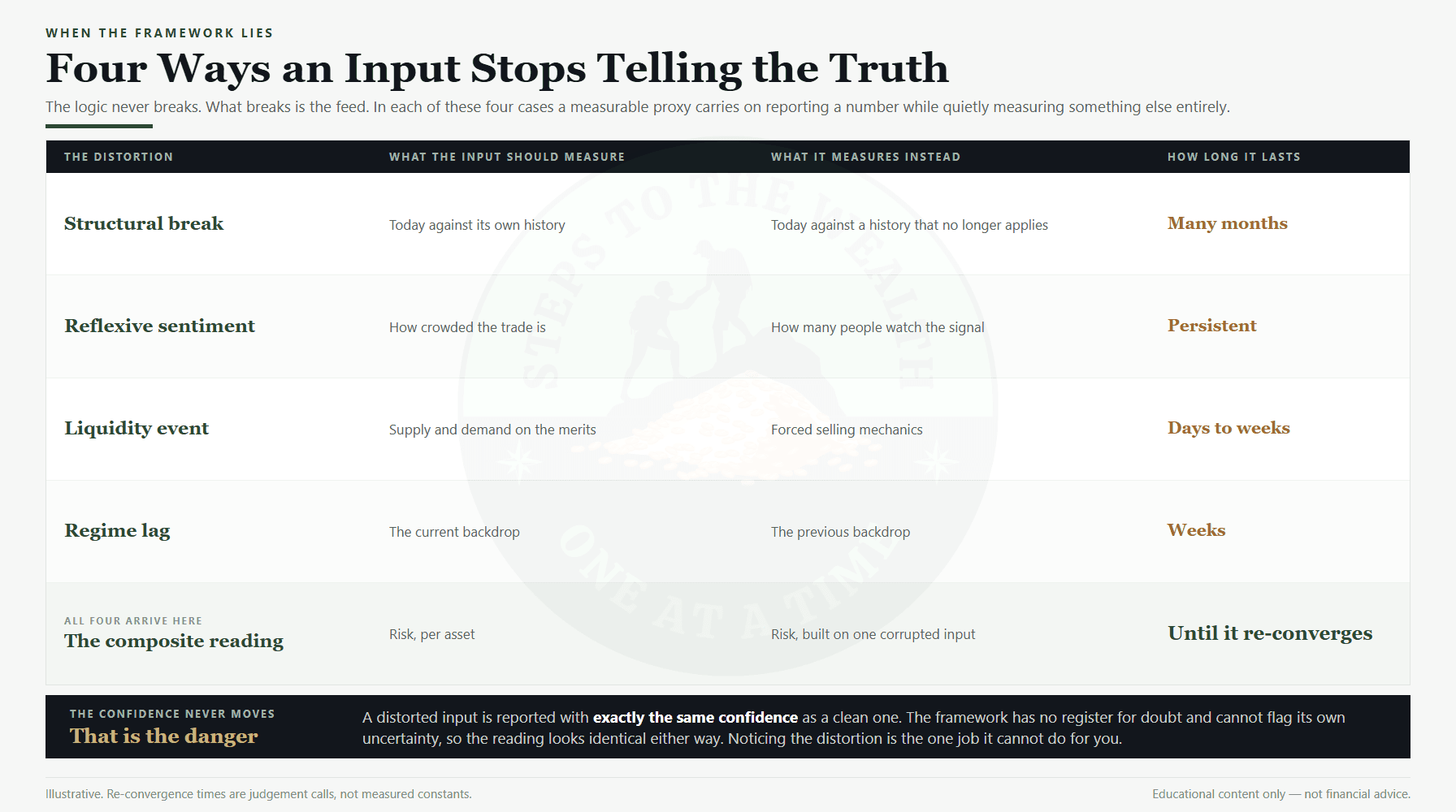
There are four mechanisms I have actually seen do this. Not four categories I invented for symmetry — four distinct ways the detachment happens, each with its own tell and its own recovery time.
Distortion one: a structural break in the data series
Every input is calculated against history. Price extension compares today to a trailing trend. Sentiment is read against its own normal range. Macro inputs are normalised against prior regimes.
All of that assumes the series is continuous — that the thing being measured today is the same thing that was measured a year ago. Sometimes it is not.
An asset that undergoes a genuine structural change has a past that no longer describes its present. A supply schedule that halves on a fixed timetable. A company that transforms its business mix. An index that reconstitutes heavily toward a new sector. The framework keeps comparing today against a baseline that has been quietly invalidated, and produces a number that is precise and meaningless.
Bitcoin is the cleanest example, because its supply schedule changes on a known date rather than gradually. The 2021 to 2022 drawdown is worth studying for exactly this reason: the historical baselines that looked authoritative going into it had been assembled across a different supply regime and a far smaller, less institutional market.
This is the legitimate version of “this time is different” — the narrow one. Most claims wearing that phrase are recency bias in a good suit. The rare real version is a discontinuity in the underlying mechanics: supply, cash flows, composition. That is the tell. If the only thing that changed is the price and the headlines, it is not a structural break.
When I suspect one, I stop trusting the historical normalisation until enough data has accumulated under the new regime for the baseline to mean something again. That can take many months. Through that window the reading stays directionally useful and stops being precise, and I size to the wider uncertainty rather than to the number.
Distortion two: sentiment that turns reflexive
Sentiment is the input most exposed to distortion, because sentiment is partly about how widespread a given kind of thinking has become — and a sentiment signal is itself a kind of thinking.
The mechanism is straightforward. Sentiment proxies work because they capture how crowded a trade is. But when enough participants watch the same signal and trade against it, the signal starts measuring how many people are watching it rather than how crowded the underlying trade actually is.
An extreme-fear reading becomes a reason to buy. Which means extreme-fear readings stop marking bottoms as cleanly as they used to, because the reading is being front-run. The proxy has become reflexive. It is measuring its own popularity.
This does not make sentiment useless. It makes it noisiest at the extremes, which is precisely where you most wanted to lean on it. When a sentiment input is screaming and I can see that the scream itself has become a widely traded narrative, I treat it as one weakened input among several rather than as confirmation. The composite still carries it. I just stop letting it dominate.
There is a broader point buried in this one. Signals decay as they spread. Anything that works and becomes widely known gets arbitraged toward uselessness, which is why a framework built on a handful of durable structural inputs ages better than one built on whatever indicator is currently fashionable. Understanding how different investors react to the same information is part of why the crowding happens at all.
Distortion three: liquidity events that move price for non-risk reasons
Price extension assumes price is moving because of supply and demand for the asset on its own merits. Usually true. Occasionally very false.
A forced-liquidation cascade. A large fund unwinding. A deleveraging event. An index rebalancing flow. A single enormous holder selling for reasons that have nothing to do with the asset. All of these move price hard, and the framework reads the move as a change in risk. It is not a change in risk. It is plumbing.
The classic shape: an asset falls thirty per cent in days, not because anything changed in its fundamentals or its macro backdrop, but because a leveraged holder was margin-called into a thin market. Price extension now reads as though risk collapsed and an opportunity opened. Perhaps it did. Or perhaps mechanical selling temporarily detached price from value and it will snap back within weeks regardless of what the reading said.
The COVID crash is the useful case study here because it contains both a genuine macro shock and a violent liquidity cascade in the same few weeks. The S&P 500 fell 33.9% in 33 days and then took 181 days in total to reclaim the prior high, on 18 August 2020. Anyone reacting to a daily reading in the middle of that was reading plumbing, not risk.
This is the main reason I read weekly composites rather than reacting to daily moves. Most liquidity distortions wash out inside a week or two, and waiting for the weekly read lets the plumbing settle before I trust the number. A large enough event can still distort a weekly composite. But when I can identify that a move was liquidity-driven rather than information-driven, I discount price extension for that asset until it normalises.
It is also the reason a mechanical contribution schedule survives these episodes better than a discretionary one. If you are investing around a full-time job, you are not watching the tape when the cascade happens, and that turns out to be a structural advantage rather than a handicap.
Distortion four: a regime change the macro input has not caught
Macro is the slowest input by design. You do not want a regime read whipsawing on every data point. The cost of that deliberate slowness is that at the exact moment a regime genuinely turns, macro is the last thing to register it.
For most turns the lag is harmless. An incremental contribution structure is forgiving enough that being a few weeks late to a regime shift costs very little. But in a sharp break — a sudden change in the rate environment, a credit event, a policy shock — the macro input can sit at its old reading for weeks while the backdrop has already changed underneath it. Through that lag, the composite describes a world that no longer exists.
The 2008 financial crisis is the reference case. The S&P 500 fell 56.78% peak to trough, needed a 131.35% gain to get back to even, and did not reclaim the prior high until 28 March 2013. The credit mechanics were deteriorating well before any macro aggregate reflected it.
I cannot fix the lag without making the input jumpy the other ninety-five per cent of the time, which would be a worse trade. What I can do is recognise when a genuine break is plausibly underway and treat the macro reading as stale until it confirms — leaning on the faster inputs and, again, sizing down through the uncertain window.
What the four have in common
Every one of these is the same failure wearing different clothes. A measurable proxy stops representing the thing it is supposed to represent, and the framework — which only sees the proxy — reports the distorted value with complete confidence.
Notice what is not on the list. “The framework gave a reading I did not like” is absent, and its absence is the whole discipline. Distortion is a property of the inputs, identifiable by a specific named mechanism: a structural break, a reflexive signal, a liquidity event, a regime lag. If you cannot name which one you are in, you are not looking at a distortion. You are looking at a reading you would like to override.
The rule: size down, never invert
So here is the rule I actually follow when the framework lies, and it is deliberately conservative.
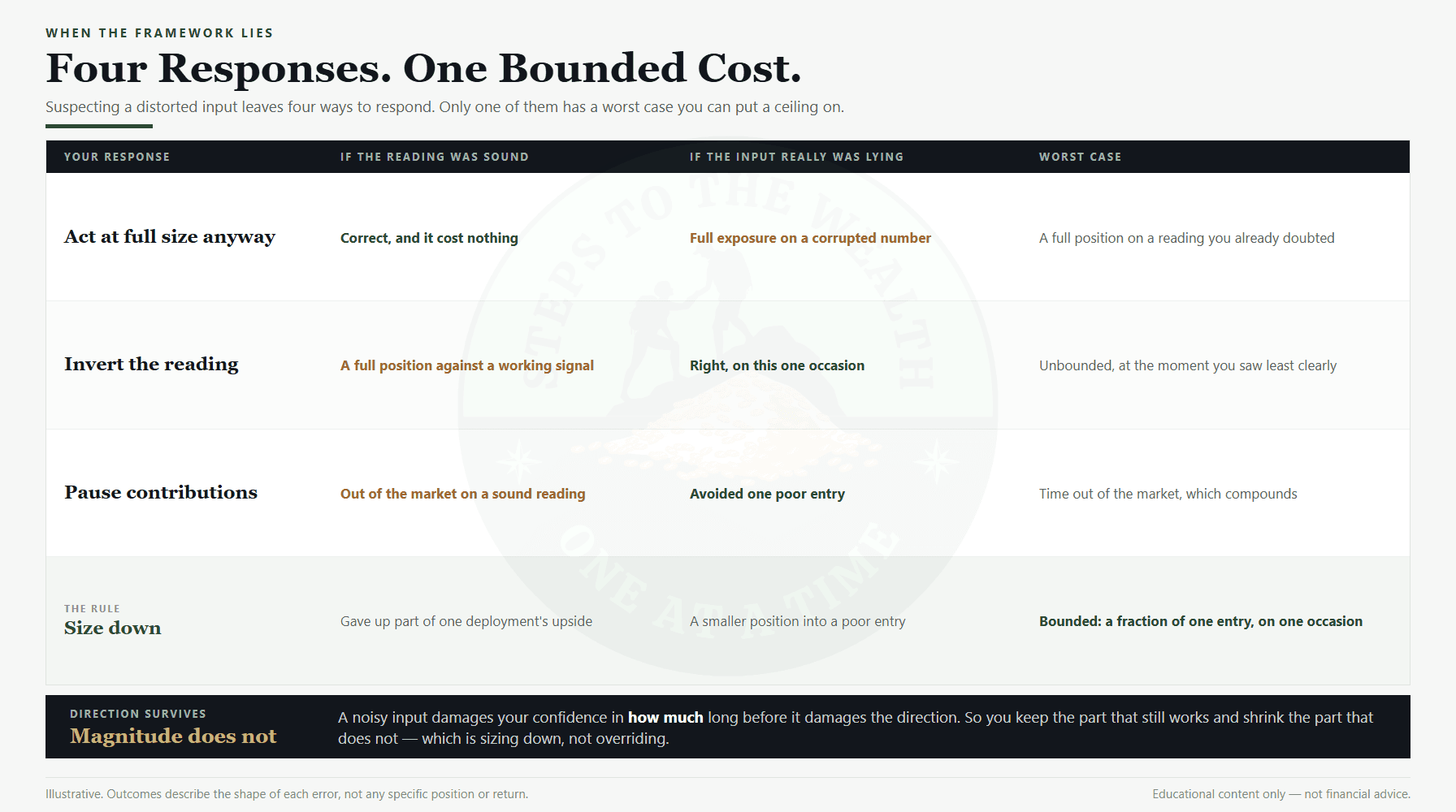
When I can identify a specific input distortion, I do not override the framework. I reduce position size and widen my uncertainty.
I do not flip the reading. I do not decide the framework is wrong and substitute my own judgement, because that is how the discipline unravels — not in one dramatic moment but through a series of individually reasonable exceptions. I simply acknowledge that this reading rests on a shakier input than usual and act on it with less conviction.
A reading I would normally size at a full rung gets a partial rung. A deployment I would normally make in one step gets spread across two. The framework still sets the direction. The distortion only lowers my confidence in the magnitude.
That distinction between direction and magnitude is the load-bearing part. Direction is what the framework is good at even when an input is noisy. Magnitude is what a corrupted input damages first. So you keep the part that survives and shrink the part that does not.
The asymmetry that makes sizing down the right response
Sizing down is not a limp compromise between two bolder options. It wins on the arithmetic, because the available errors are not the same size.
If you size down and the reading was fine, you gave up some upside on one deployment. The cost is real and it is bounded — a fraction of one position’s gain, on one occasion.
If you invert the reading and you were wrong, you took a full position against a signal that was working, in conditions you had already flagged as uncertain. That cost is not bounded in the same way, and it arrives at the worst possible time, because the whole reason you were in this situation was that you could not see clearly.
Pausing contributions altogether is the other tempting response, and it fails for a different reason. It converts a short-lived input problem into time out of the market, which is the one cost that never comes back. A distortion lasts weeks or months. The compounding you skip lasts for the rest of the horizon.
The lump-sum versus staged deployment comparison makes the same point in a different setting: staging costs you a little expected return in exchange for a large reduction in the damage a bad entry can do, which is the same logic behind measuring progress against a long horizon rather than a single quarter. Under distortion, when your confidence in the reading is explicitly lower, that trade gets more attractive, not less.
There is also a decent body of evidence that acting more does not pay. Barber and Odean’s study of 66,465 households from 1991 to 1996 found the market returned 17.9% annually, the average household 16.4%, and the busiest fifth of traders 11.4%. The gap between the market and the most active group is 6.5 percentage points a year. Distortion is a condition that tempts you to act more. The data says the temptation is expensive.
How to tell a distortion from an excuse
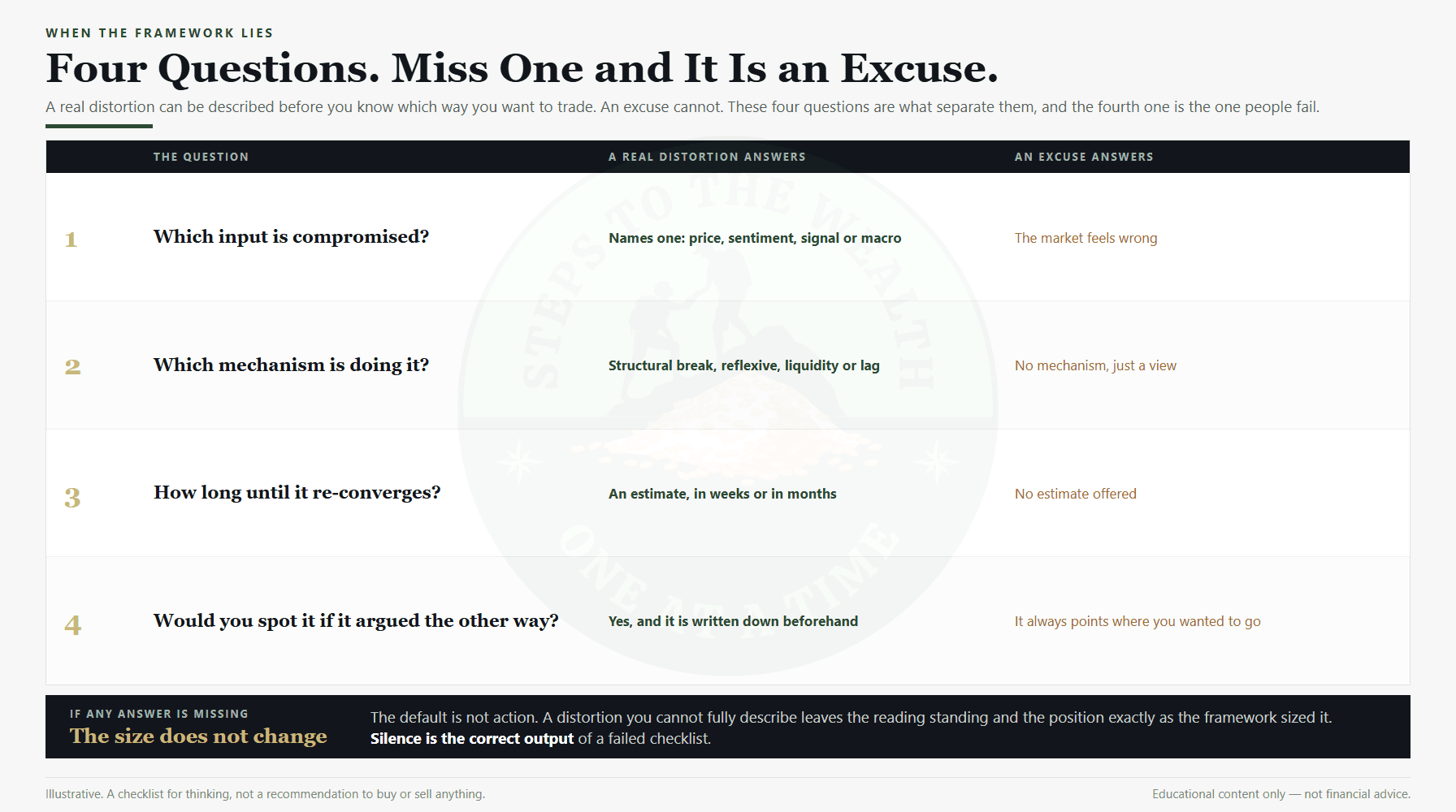
The honest test is whether you can name the mechanism before you know which way you want to act.
A real distortion has a specific structure. You can point at which input is compromised. You can say why it detached — which of the four mechanisms is operating. You can state roughly how long it should take to re-converge. And critically, the distortion is identifiable independently of whether it argues for buying or selling.
An excuse fails that last test. It always happens to point in the direction you already wanted to go. If your identified distortion conveniently means “buy more” every time you are feeling bullish, you have not found a distortion. You have found a rationalisation with technical vocabulary.
A useful discipline is to write down which input you think is compromised, and what would have to be true for you to be wrong about that, before you touch the size. If you cannot complete the second half of that sentence, you are not in a distortion. Running the numbers through a portfolio stress test is a more honest exercise than arguing with the reading, because it asks what happens if you are wrong rather than what happens if you are right.
The other check is frequency. If you are identifying input distortions more than a couple of times a decade, you are not finding them. You are manufacturing them. Genuine ones are rare, which is exactly what makes the rest of the readings worth following. The same discipline applies to the slowest drawdowns, where the temptation to reinterpret the reading lasts for years rather than weeks. Most of what people believe about contribution strategy is similarly built on exceptions that felt more common than they were.
Why naming the failure modes makes the framework stronger
It would be easier to sell a framework with no failure modes. Most investing systems are marketed exactly that way: flawless, always on, never wrong. That marketing is its own kind of input distortion, warping your sense of how much certainty any system can honestly provide.
A framework is a set of proxies, and proxies have conditions under which they detach from what they proxy. Knowing when the framework lies is a property of the system you can study in advance, not a surprise you absorb in the moment. Knowing those conditions is what lets you trust the framework the rest of the time. If I pretended the inputs were never distorted, then the first time you hit one you would either get blindsided or lose faith in the whole system. Naming the failure modes in advance keeps your trust calibrated instead of brittle.
This is also why the risk-first sequence puts structure before selection. A framework that is honest about its limits gives you something to do when a reading is unreliable. A framework that claims to have none leaves you with nothing but your own judgement at the exact moment your judgement is least reliable.
The cost of getting this wrong compounds in the direction people underestimate. Time in the market is the dominant variable, and the cost of waiting is paid in the years you were out rather than in the entry price you were arguing about. A distortion is a reason to size down for a few months. It is never a reason to stop.
If you think you are in one right now
Work through it in order, and be strict about it.
Name the compromised input. This is the first question to answer when you suspect the framework lies, and it is not “the market feels wrong” — which of price extension, sentiment, the underlying-signal layer, or macro is the one you believe is detached.
Name the mechanism. Structural break, reflexive signal, liquidity event, or regime lag. If it is none of those four, it is not a distortion.
State the re-convergence window. Weeks for a liquidity event. Months for a structural break. If you cannot estimate it, you do not understand the distortion well enough to act on it.
Check the direction test. Would you have identified this distortion if it argued the other way? If the answer is no, stop.
Then size down. Not out, and not inverted. Down. Keep contributing on the schedule, take the smaller rung, and let the input re-converge before you act with full conviction again. The arithmetic of staying invested does not pause while you wait for clarity, and a broad, boring allocation approach is more robust to a single distorted input than a concentrated one is.
The framework does not lie often. When the framework lies, it is not because the logic failed. It is because an input got distorted in one of four specific, recognisable ways. Learn to spot them, then do the boring thing: size down, widen the uncertainty, and let the inputs re-converge.
Trust the framework. Just know exactly when to trust it a little less.
Educational content only. Not financial advice. No framework or model removes the risk of loss, and the situations described here are judgement calls that depend on individual circumstances. The historical figures cited are worked examples of past market behaviour, not forecasts. Work with a qualified financial professional before acting on any of this.