
Knowing when not to invest is a skill almost no one teaches, because it does not sell. The entire investing industry is built on the assumption that the answer is always buy more, buy now. But a system that only knows how to add exposure is not a system — it is a one-way bet. The investors who last through multiple cycles are the ones who learned that sitting out, scaling back and holding cash are moves, not failures. This is the other half of the framework: the discipline of doing less when the odds say do less.
Is holding cash actually a position?
Yes — holding cash is an active position, not a failure to act, and treating it that way is the first shift toward risk-first investing. When you hold cash deliberately because the risk reading is elevated, you are making a decision with a thesis behind it: the downside is stretched, the odds of a large drawdown are higher than usual, and preserving capital now buys you the ability to deploy it later at better prices.
The market does not reward you for being invested at all times. It rewards you for being invested at the right times and protected at the wrong ones. Cash is how you stay protected without leaving the game. If that framing feels uncomfortable, it is worth sitting with why — the discomfort is usually the fear of missing out, and the same reframe sits underneath the whole risk-first approach to getting started.
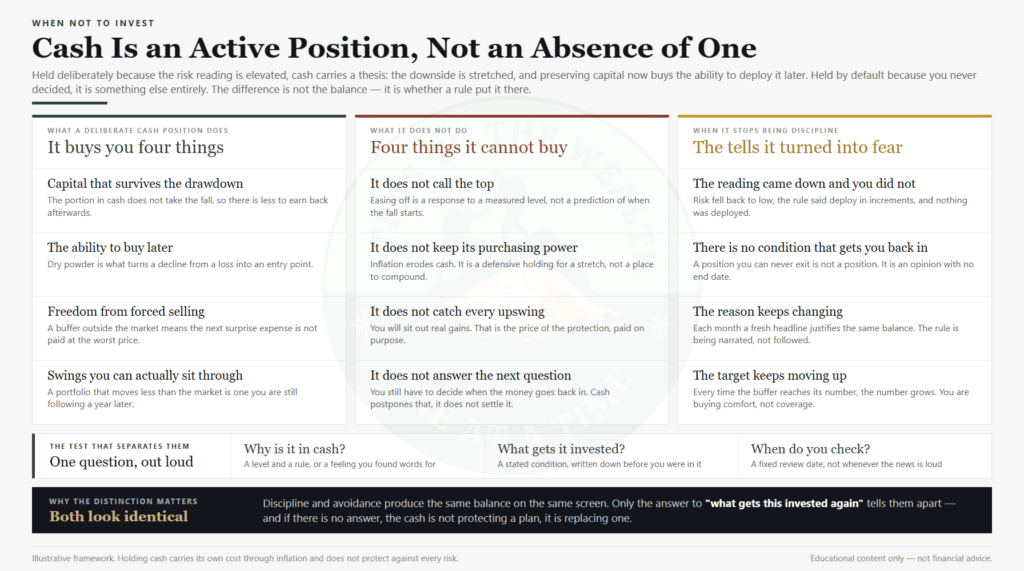
The honest version of this argument includes its cost. Cash loses purchasing power to inflation, it will not catch every upswing, and it does not tell you when the fall starts. What it does is keep a portion of your capital out of the drawdown and leave you with something to deploy afterwards. That is a trade, not a free option, and it is worth making only when the reading says the odds have shifted.
When should you not invest more money?
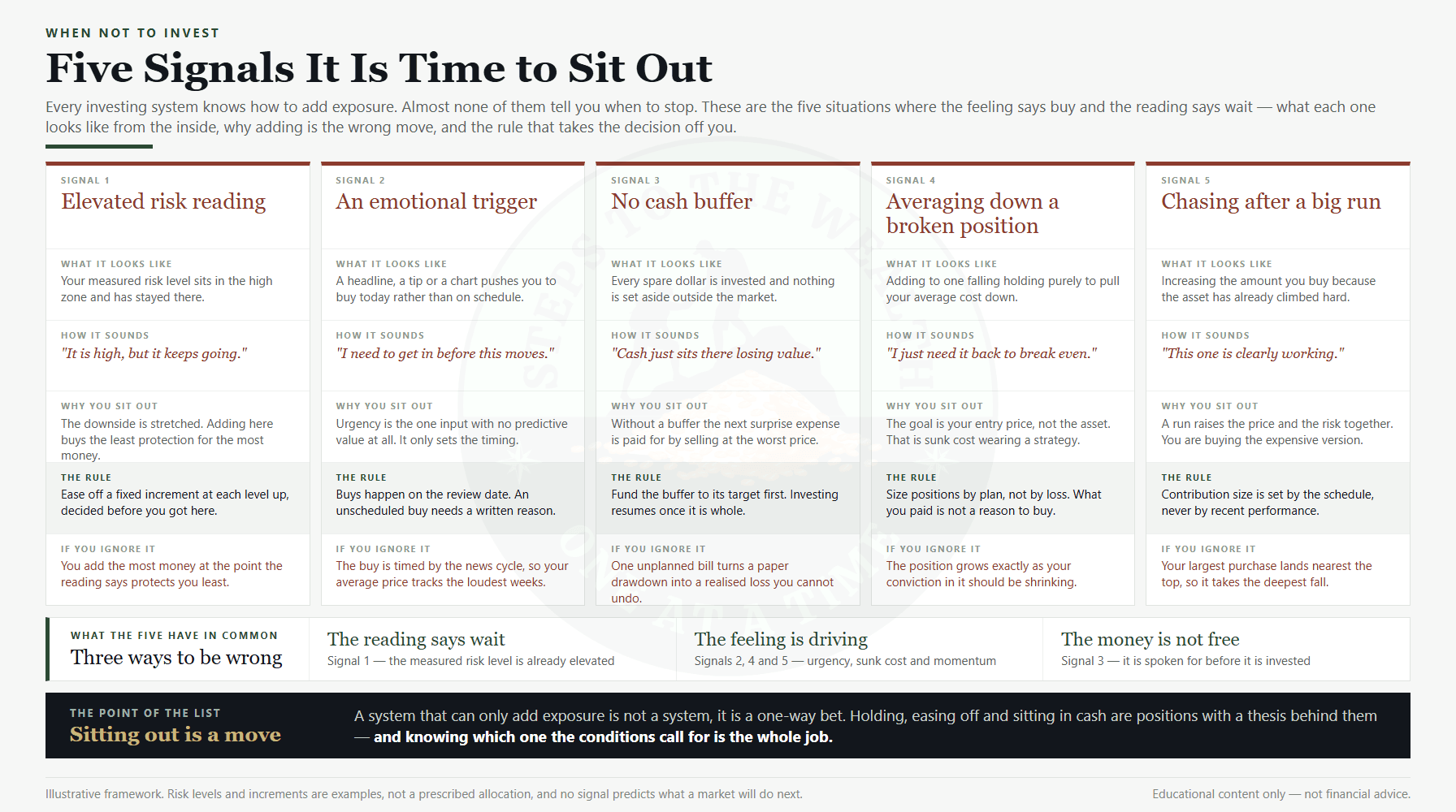
You should not invest more when a measured risk reading is elevated, when you are acting from emotion rather than a rule, or when the money itself should not be at risk yet. Those three categories cover almost every case where adding exposure is the wrong move. Here are the five specific signals that fall inside them.
| Signal | What it looks like | Why you sit out |
|---|---|---|
| Elevated risk reading | Your risk metric is in the high zone and has stayed there | The downside is stretched; adding here buys the least protection for the most money |
| Emotional trigger | You want to buy because of a headline, a tip or the fear of missing out | Urgency has no predictive value at all. It only sets the timing |
| No cash buffer | You have no emergency fund outside the market | Forced selling at the worst possible price is the real risk |
| Averaging down a broken position | Adding to a single falling asset purely to lower your cost | The goal has become your entry price, not the asset. That is sunk cost |
| Chasing after a big run | Buying more because it already went up a lot | A run raises the price and the risk together |
Read the middle column. Every one of these is a situation where the feeling says buy and the data says wait. That gap is precisely where a rule earns its keep. The fourth signal is worth naming plainly, because it is the one that dresses up as conviction: adding to a position to pull your average cost down is a decision about the price you paid, not about the asset in front of you. The same instinct shows up when people defend the wrong line item in a budget — the number that feels significant is rarely the number that matters.
The fifth is the one that catches disciplined investors, because it arrives disguised as evidence. An asset that has climbed hard looks like it is working. What has actually happened is that the price went up while the underlying case did not change, which means the risk went up too. It is the same reasoning error behind the belief that the right entry moment can be identified in advance.
Why is knowing when not to invest so hard?
Knowing when not to invest is hard because every incentive in your environment pushes the other way, and doing nothing feels like failing even when it is the correct move. Your feed is full of people buying. The platforms are built to make trading frictionless and constant. And your own psychology treats inaction as a missed opportunity rather than a preserved one.
There is also a deeper trap: when you sit out and the market keeps rising, it feels like the system was wrong. It was not. Managing risk means accepting that you will sometimes leave gains on the table in exchange for avoiding the drawdowns that actually break portfolios. That trade is the whole point — and the arithmetic behind it is not a matter of opinion.
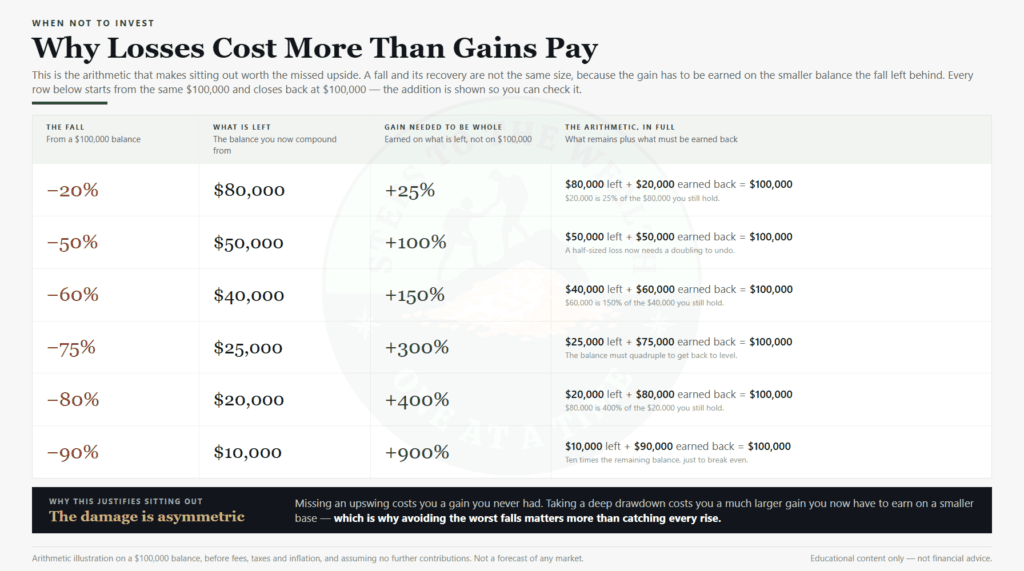
Start with $100,000. A 20% fall leaves $80,000, and getting back to $100,000 means earning $20,000 on that smaller balance — a 25% gain, not a 20% one. A 50% fall leaves $50,000 and needs another $50,000, which is a 100% gain. At a 75% fall you hold $25,000 and need $75,000 back, so the balance has to quadruple. The gap widens the deeper the fall goes, because the gain is always earned on what survived, never on what you started with.
This is why the investor who never misses an upswing is also the investor who never misses a crash, and why that is a bad trade. Missing a rise costs you a gain you never had. Taking a deep drawdown costs you a much larger gain that you now have to earn on a smaller base. The 2008 crisis is the clearest example on record: the S&P 500 fell 57.00% and did not reclaim its high until 28 March 2013. The 2020 crash fell 33.9% and round-tripped in 181 days, and the 2021 to 2022 bitcoin decline was deeper again. Same arithmetic, three very different waits.
Worth being precise about one thing: none of this says a drawdown is avoidable, or that sitting out reliably dodges one. It says the cost of being in for the worst of a fall is larger than the cost of being out for part of a rise, which is a different and much more defensible claim. If you want to see what a specific mix would have done through those windows rather than take that on trust, that is what a portfolio stress test is for.
How do you decide when not to invest without guessing?
You decide when not to invest by tying the decision to a pre-set rule and a measured risk reading, so it never depends on how you feel in the moment. Guessing is what happens when you have no rule — you end up reacting to whatever is loudest that week. A rule replaces the guess with a mechanism.
The mechanism, in four parts:
- Define elevated in measurable terms. Decide in advance what risk level means slow down or stop. A number, not a mood.
- Pre-commit the action. Write down what you do at each risk level — build, hold, ease off, scale out — before you are standing in it.
- Scale, do not switch. You are rarely all-in or all-out. You move in increments, easing off a fixed step at a time as risk rises and adding it back the same way as risk falls.
- Review on a schedule, not on impulse. Check once a week. Between reviews the decision is already made, which removes the temptation to react.
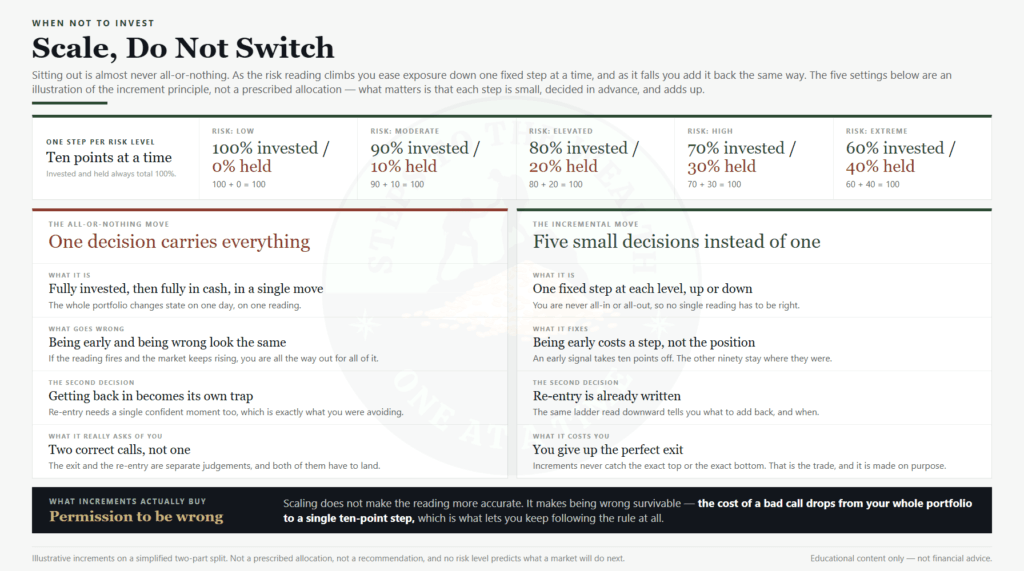
The third part carries most of the weight. An all-or-nothing move puts your entire portfolio on one reading on one day, and it quietly requires two correct calls rather than one, because getting back in is its own decision. Increments make being wrong survivable: an early signal takes a step off and leaves the rest where it was, and the same ladder read downward tells you what to add back and when. That is also the honest cost of the approach — you will never catch the exact top or the exact bottom, and you are giving that up deliberately.
Sizing the step matters more than most people expect, which is the same reason how you deploy a large sum changes the outcome more than when you deploy it. The result is that when not to invest stops being a judgement call you agonise over and becomes a reading you glance at. The system carries the discipline so you do not have to summon it under stress.
What about the fear of missing out?
The fear of missing out is the single strongest force pulling investors into buying when they should be sitting out, and the only durable defence is a rule you trust more than the feeling. FOMO is not stupidity — it is a rational response to watching others get rewarded. But it is calibrated to the short term, and investing is a long-term game. The asset that ran 40% while you sat in cash may well give it all back, plus more, in the next drawdown you avoided.
Here is the reframe that holds up under pressure: you are not trying to catch every move. You are trying to be positioned correctly across a full cycle. Missing a top is not the same as losing money. Buying that top usually is. When the fear spikes, the answer is not to override the system with willpower — willpower fails exactly when you need it. The answer is to have already decided, on a calm day, what you do when this feeling arrives. Then you just execute the decision your calmer self already made.
Building that decision into a fixed weekly slot is what makes it stick, and it is the same reason a short repeatable routine beats an ambitious one when you have a full-time job. A rule you actually follow at a low level of effort outperforms a better rule you abandon in month three.
When should the money not be invested at all?
Some money should not be in the market regardless of what the risk reading says, and that is the third signal doing its work. If you have no buffer outside the market, the next unplanned expense gets paid for by selling — and it will not be sold at a time of your choosing. That is how a paper drawdown becomes a realised loss.
The same applies to money already committed elsewhere. High-rate debt has a certain, contractual cost that most portfolios cannot reliably beat, and the true cost of paying only the minimum is usually far larger than it looks on the statement. Money earmarked for a near-term purchase belongs in the same category, because the real cost of that purchase already has a claim on it. In each case the answer is not a market view. It is that the money was never free to invest.
When is sitting out the wrong call?
Sitting out is the wrong call when it becomes permanent — when caution curdles into never investing at all. There is a failure mode on this side too. The investor so afraid of loss that they hold cash through years of low-risk, favourable conditions does not preserve wealth. They forgo it. Risk-first does not mean risk-never.
The tells are specific. The reading came down and you did not. There is no stated condition that would get you back in. The reason changes every month while the balance stays the same. Any of those means the cash is no longer protecting a plan, it is replacing one.
It is also worth checking the drift the other way: cash that sits long enough tends to get spent, and a rising standard of living quietly absorbs it, which is the mechanism behind lifestyle creep eating a savings rate. Waiting is not free either — the cost of waiting compounds just as reliably as the cost of a drawdown, and against a long-horizon savings target the gap shows up plainly.
The framework cuts both ways for a reason. When the risk reading is low, sitting out is no longer discipline — it is fear wearing discipline’s clothing, and it costs you the returns you were trying to protect. The same system that tells you when not to invest also tells you, clearly, when you should. Sitting out is a tool for high-risk conditions. Deploying gradually is the tool for low-risk ones. Using the wrong tool for the conditions is the mistake, in either direction. For the general principle of splitting capital across assets and cash, the SEC’s investor education arm has a plain-language primer on asset allocation.
Let the risk reading tell you when to sit out
Knowing when not to invest is easy to agree with and hard to do, because it means acting against the feeling in the moment. A weekly risk reading removes the judgement call: it tells you, in plain terms, when to build, when to hold and when to ease off.
That reading is what Steps To The Wealth Weekly delivers every Sunday, across five major assets, with the action each risk level calls for.
No predictions. No hype. Just the signal that tells you when doing nothing is the right move.
Frequently asked questions
When should you not invest more money?
You should not invest more when a measured risk reading is elevated, when you are acting from emotion rather than a pre-set rule, or when the money should not be at risk yet — for example, if you have no emergency buffer outside the market. Each of these is a case where the feeling says buy but the data says wait.
Is holding cash a good investment position?
Held deliberately, cash is an active position, not a failure to act. When the risk environment is stretched, holding cash preserves capital and gives you the ability to deploy it later at better prices. It has a real cost — inflation erodes it and you will miss some gains — so it is a defensive holding for a stretch, not a place to compound.
How do I know when to stop investing and wait?
Tie the decision to a rule set in advance and a measured risk reading, rather than to how the market feels. Define what elevated risk means as a number, pre-commit the action for each level, move in increments rather than all at once, and review on a fixed weekly schedule instead of reacting to impulse.
Should I sell everything when risk is high?
Rarely. Risk-first investing generally means scaling back in fixed increments, not switching entirely to cash in one move. All-or-nothing decisions concentrate the risk of being wrong on a single moment, and they require a second correct call to get back in, which is exactly what a rules-based system is designed to avoid.
Why does a drawdown need a bigger gain to recover?
Because the recovery is earned on the smaller balance the fall left behind. A 50% fall on $100,000 leaves $50,000, and earning the missing $50,000 back on that balance is a 100% gain. A 75% fall leaves $25,000 and needs $75,000 back, which is a 300% gain. The deeper the fall, the wider that gap gets.
Can being too cautious cost me money?
Yes. Sitting out during low-risk, favourable conditions is not discipline — it is fear, and it forgoes returns you were trying to protect. The tell is that there is no stated condition that would get you invested again. Risk-first does not mean risk-never.
Educational content only — not financial advice. Examples and historical figures are for illustration and do not predict future results.