
A reader sent me a screenshot of everything they own and asked one question: “Is this any good?”
I cannot answer that, and neither can anybody else working from a list of holdings. Good depends on age, income stability, family obligations, tax position and risk capacity, none of which a screenshot reveals. What I can do is run a portfolio audit: the same four structural questions the framework asks of every portfolio, in the same order, whether it holds $40,000 or $4 million.
So I built a composite. The portfolio below is not one person’s. It is stitched together from the patterns that turn up again and again when working professionals show me what fifteen years of reasonable-in-the-moment decisions produced. Every figure in it is illustrative. Most people recognise a piece of themselves in it anyway.
Educational content only. Not financial advice.
The portfolio, as it arrived
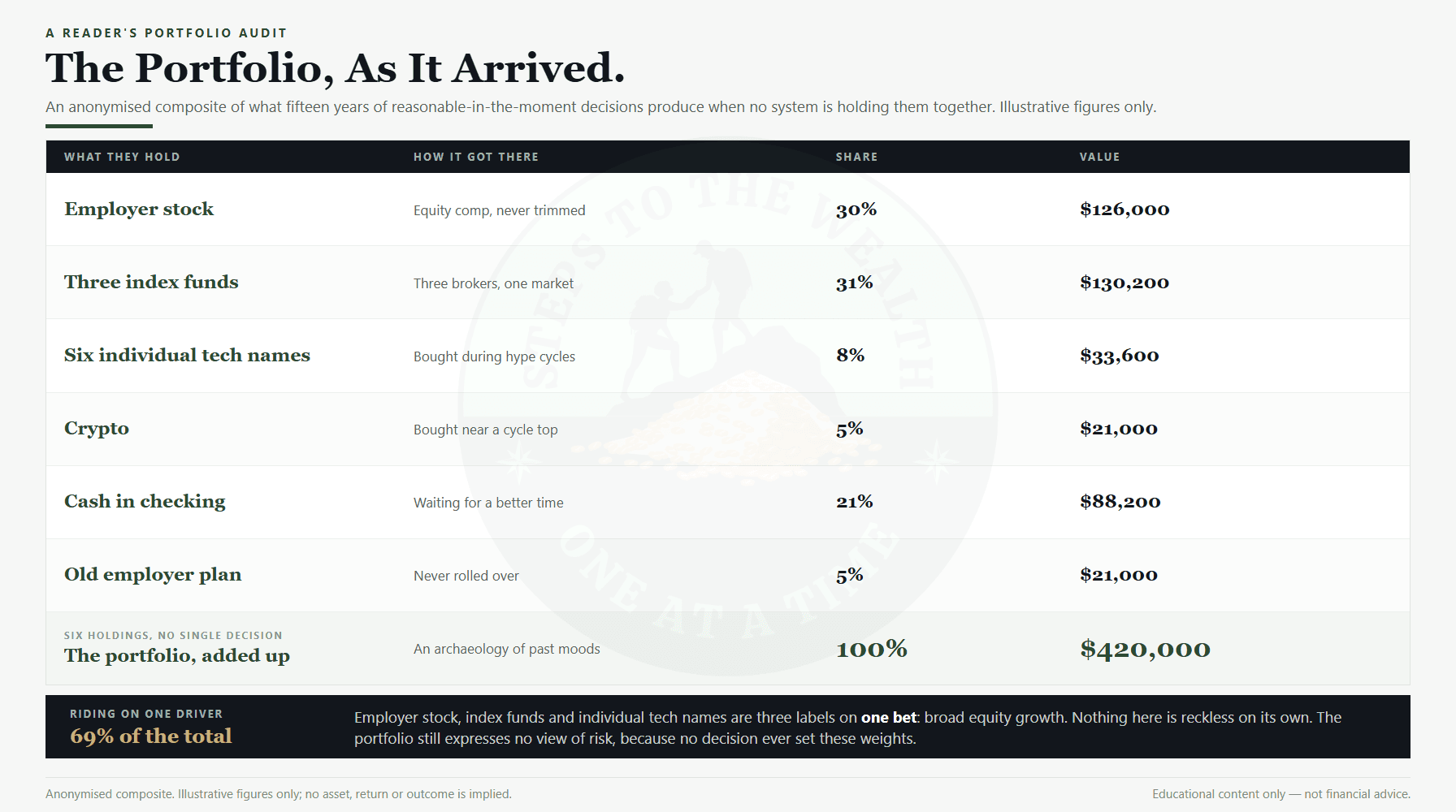
A working professional in their late thirties. Stable, high income. Roughly fifteen years of investing accumulated across accounts opened at different jobs, with different brokers, in different moods. Total investable assets of $420,000.
Employer stock is the largest single line at 30%, or $126,000, accumulated through equity comp and never trimmed. Three broad-market index funds held at three brokers come to 31%, or $130,200. Six individual tech names bought during assorted hype cycles add up to 8%, or $33,600. A crypto position bought near a previous cycle top is 5%, or $21,000. Cash sitting in checking is 21%, or $88,200. An old employer’s retirement plan, never rolled over, is the final 5%, or $21,000.
Nothing there is reckless. Every one of those decisions was defensible on the day it was made, which is exactly the point. The problem is not any individual holding. The problem is that the portfolio as a whole expresses no view of risk at all. It is an archaeology of past moods, and the weights were set by whatever was happening in the reader’s life when the money arrived.
What a portfolio audit actually is, and what it is not
An audit is not a verdict on your holdings and it is not a shopping list. It is a structural review with a single question underneath it: does the shape of this portfolio reflect a decision, or an accumulation?
The logic runs backwards from the outcome most people say they want. For a portfolio to come through a drawdown intact, position sizes have to be deliberate. For sizes to be deliberate, a rule has to set them. For a rule to set them, there has to be a reading of risk it answers to. So the audit never opens at “what should I buy.” It opens three steps earlier, at whether anything is setting the weights at all.
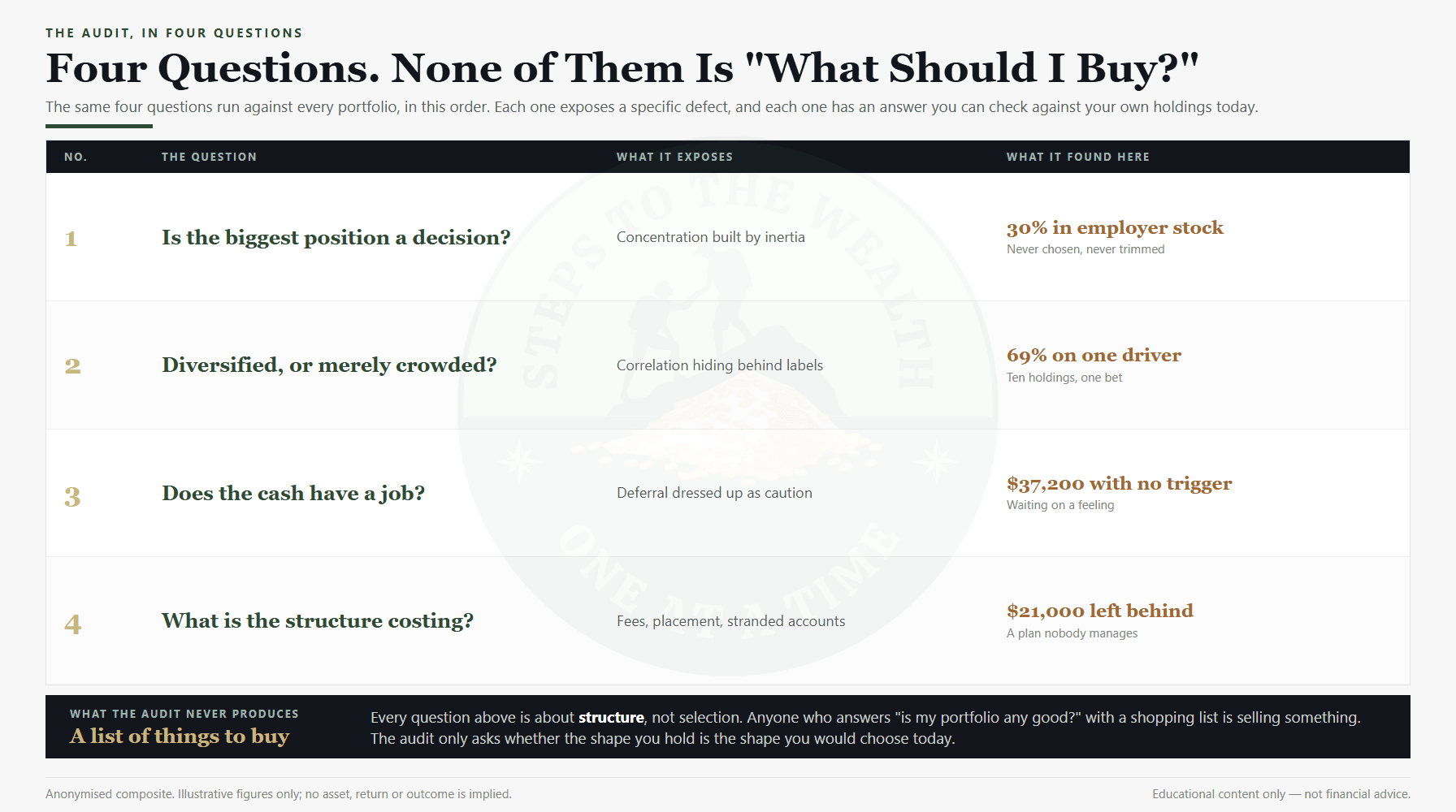
That is the same risk-first sequence the framework applies before opening any new position. Running it against holdings you already own changes nothing except the starting point. Four questions, in this order, and none of them is about selection.
Question one: is your biggest position a decision, or an accident?
The employer stock is the largest holding at 30%. Not because the reader concluded it was their best risk-adjusted bet. It arrived through equity comp, one vesting event at a time, and was never trimmed.
This is the most common pattern I see and the most dangerous one: the biggest position in the portfolio is the position nobody chose. Inertia set it, and inertia will keep setting it until something interrupts.
The framework’s sizing logic runs the other direction. Size is an output of a risk reading and a conviction level, not an accident of where money happened to land. The question is not “how much of this do I have?” It is “if I were building this position from cash today, at today’s reading, how much would I put in?” For most people holding a large employer position, the honest answer is well below what they already hold.
There is a second exposure hiding underneath the first. Your salary and your largest holding depend on the same company. A bad year there arrives twice, once in the portfolio and once in the pay packet, potentially in the same quarter. That correlation never shows up on a brokerage statement. It is the specific reason employer-stock concentration deserves different treatment from any other kind, and working professionals carry it more often than they notice, because the investing they do around a full-time job is funded by that same employer.
The arithmetic is worth doing once, because it is not intuitive. A 50% fall in a position that is 30% of the portfolio takes 15% off the total on its own, before anything else in the account moves. Running the same exercise against your own largest holding in a portfolio stress test usually produces a bigger number than expected.
The audit does not say sell it all. Forced selling has tax consequences, concentrated positions often carry restrictions and blackout windows, and a panic exit is just the accidental decision running in reverse. The finding is narrower and more useful than that: this position is large by inertia rather than by choice, and the gap between what you hold and what you would choose to hold today is the most important number in the portfolio.
What deliberate reduction looks like is unglamorous, and that is the point. A fixed fraction of each vesting tranche sold on receipt, so fresh concentration stops accumulating while the existing block is worked down separately. A target weight decided once, in a calm week, and written down. A trading window that respects the blackout calendar, so the decision is never taken in the fortnight after an earnings surprise. None of that requires a view on the company, which is precisely why it survives contact with a bad quarter.
Question two: are you diversified, or just crowded?
Three index funds, bought at three brokers, at three different times. The reader files that under diversification. It is redundancy. All three track essentially the same broad market, so they move as one: three tickers, one exposure, and three sets of paperwork to reconcile every year.
The deeper problem sits one level up. The employer stock, the six tech names and the index funds are all exposures to the same driver, which is broad equity growth. Sorted by driver rather than by label, 69% of this portfolio is a single bet. When that driver does well, everything rises together and the portfolio looks robust. When it falls, which is the exact scenario diversification exists to soften, everything falls together.
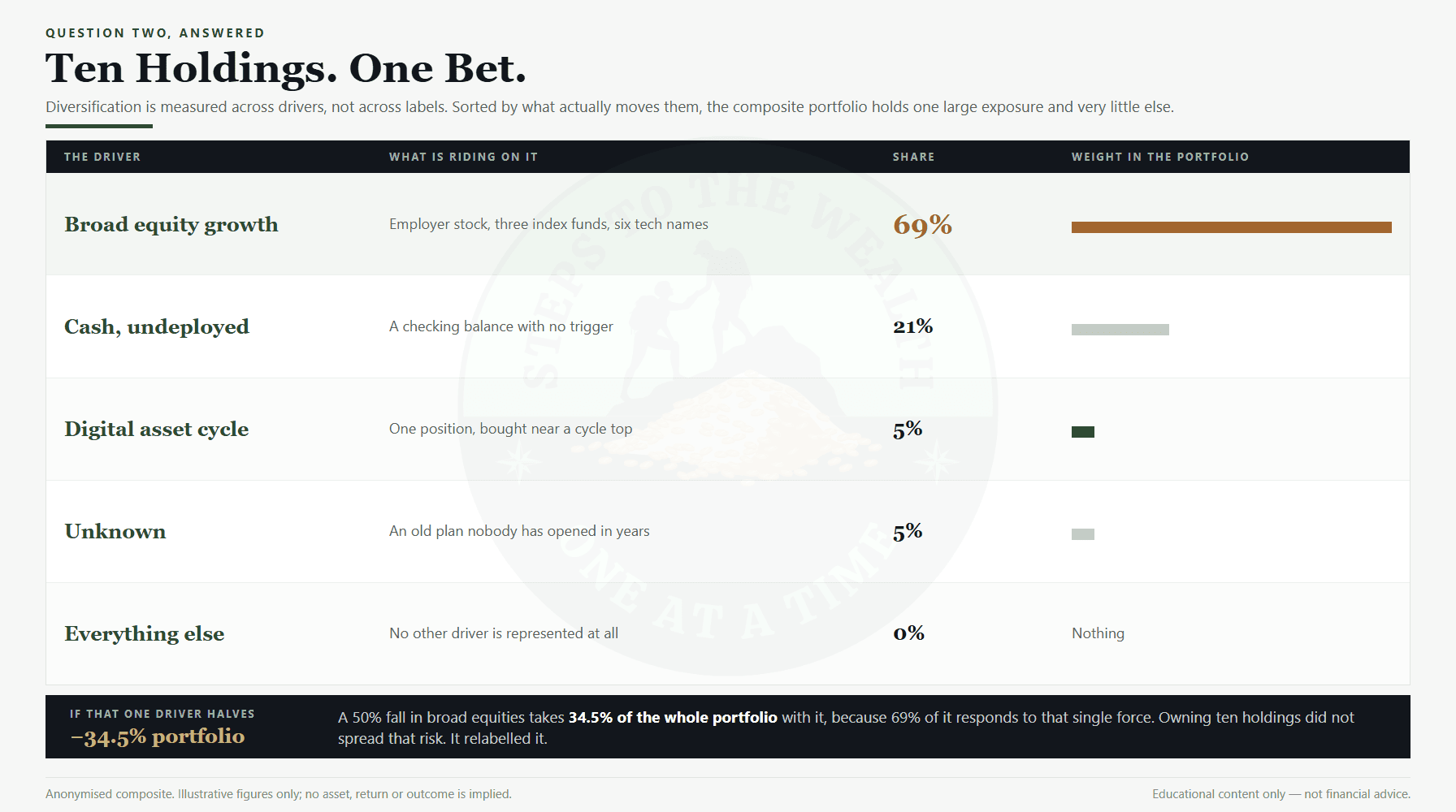
That is the distinction the framework cares about: diversification across drivers, not across labels. Ten holdings that respond to the same force are one position wearing ten names. The asset allocation primer at investor.gov makes the same point in plainer language, and it is worth reading precisely because it is not selling anything.
2008 is the case people misremember the shape of. Holdings that looked unrelated behaved identically once the drawdown deepened, and the S&P 500 through the 2008 crisis is the reference case for how a portfolio of many names can act like one. Crypto compresses the same lesson into a shorter window: this position was bought near a cycle top, and the 2021 to 2022 bitcoin drawdown shows what that costs and how long it takes to work through.
Consolidating three overlapping funds into one is housekeeping, and it is worth doing. The real finding is that apart from a 5% crypto sleeve, this portfolio holds no meaningful exposure to any driver except broad equity growth, and has never been tested against the conditions where that matters. Replaying a mix like it through historical shocks answers that question without forecasting anything.
Naming the missing drivers is where most people want a recommendation, and it is where the audit stops. What a second driver means is only this: an exposure that does not answer to the same force as the first one, and that you can explain in a sentence without using the word diversification. Whether that is duration, real assets, cash held as a deliberate position, or nothing at all is a decision about your own risk capacity, not a line an article can fill in for you. The finding stands on its own regardless: right now, there is nothing in the second column.
Question three: does your cash have a job?
There is $88,200 sitting in checking, waiting for a better time to invest.
Cash is not automatically a defect. Cash held deliberately, sized against the current reading, with a defined job and a trigger that releases it, is a legitimate position and the framework uses it as one. The audit’s question is only whether this particular cash is that, or whether it is deferral wearing caution as a costume.
The tell is the language. “Waiting for a better time” is a feeling. A framework statement sounds different: risk currently reads high, so I am holding elevated cash, and I deploy on this schedule as the reading drops. That cash has a trigger. The reader’s cash is waiting for a signal they have no method for recognising, which means it waits indefinitely and calls that patience.
So the audit splits the pile into three parts and labels each. At $6,500 of monthly expenses, six months of buffer is $39,000, and that money sits outside the framework entirely. A known near-term obligation takes another $12,000. What remains is $37,200 of undeployed money with no job at all: 8.9% of the portfolio, shedding roughly $1,116 of purchasing power a year at 3% inflation while it waits for an instruction that never comes.
That last bucket is what gets put to work on a schedule rather than on a feeling. Not all at once and not on a forecast. The cost of waiting is real and measurable, and so is the risk of dropping a lump sum into an elevated reading. The lump sum versus dollar-cost averaging comparison lays that trade out honestly, and most of the myths about dollar-cost averaging survive because people argue it as a belief instead of modelling it. Model the schedule against your own numbers in the DCA simulator before committing to one.
The buffer itself deserves one honest sentence, because it is the number people copy without thinking. Six months is a starting point for a stable salary in a liquid industry with two incomes in the household. Twelve is closer to right for a single income, a variable bonus, a specialised role that takes a long time to replace, or anyone whose employer also happens to be their largest holding. This reader is in the second group on the last count alone, which is one more reason the concentration finding and the cash finding are the same finding wearing different clothes.
Question four: what is the structure quietly costing you?
The stranded plan at the old employer is the quietest line in this portfolio and often the most expensive one. It is $21,000, sitting in a default option nobody chose, allocated according to a decision made on a first day years ago. Sometimes it is not invested at all.
This is not a question about asset selection. It is about structure: what the wrapper costs, what the default fund charges, and which assets sit in which account type. The same holding can produce a materially different after-tax result depending on where it lives, and that difference compounds quietly for decades. None of it requires a market view, which is why it is both the most reliable return in the exercise and the least discussed.
Placement is the part worth understanding once, because it is mechanical. Assets that throw off income taxed at the highest rate are the ones that benefit most from a sheltered wrapper; assets already taxed lightly gain the least from occupying that scarce space. The rules differ by jurisdiction and the details matter, so this is a question to take to a professional rather than to an article. But the audit can always identify the symptom without knowing the local rules: holdings that landed wherever an account happened to be open, and a wrapper allowance nobody has consciously spent.
Two related structural questions belong in the same pass. The first is contributions: the audit checks whether the monthly amount going in has kept pace with income, because lifestyle creep absorbs raises so smoothly that most people never notice their savings rate falling. The second is debt. Any balance costing more than a portfolio can reasonably expect to earn is a negative-return holding in disguise, and the minimum payment on a revolving balance is designed to keep it that way.
Context helps here, as long as it stays context. Where you sit relative to your own age band, as in the retirement savings by age benchmarks, is useful for calibration and useless as a target, because the distribution behind those numbers is wide and your obligations are not the median’s. The same goes for the near-term obligation in the cash pile: whether that $12,000 purchase is worth what it costs is a separate exercise, and the true cost of a purchase covers it properly.
What the framework would change, and what it would leave alone
Put the four findings together and the audit produces a short list. Half its value is in what stays off that list.
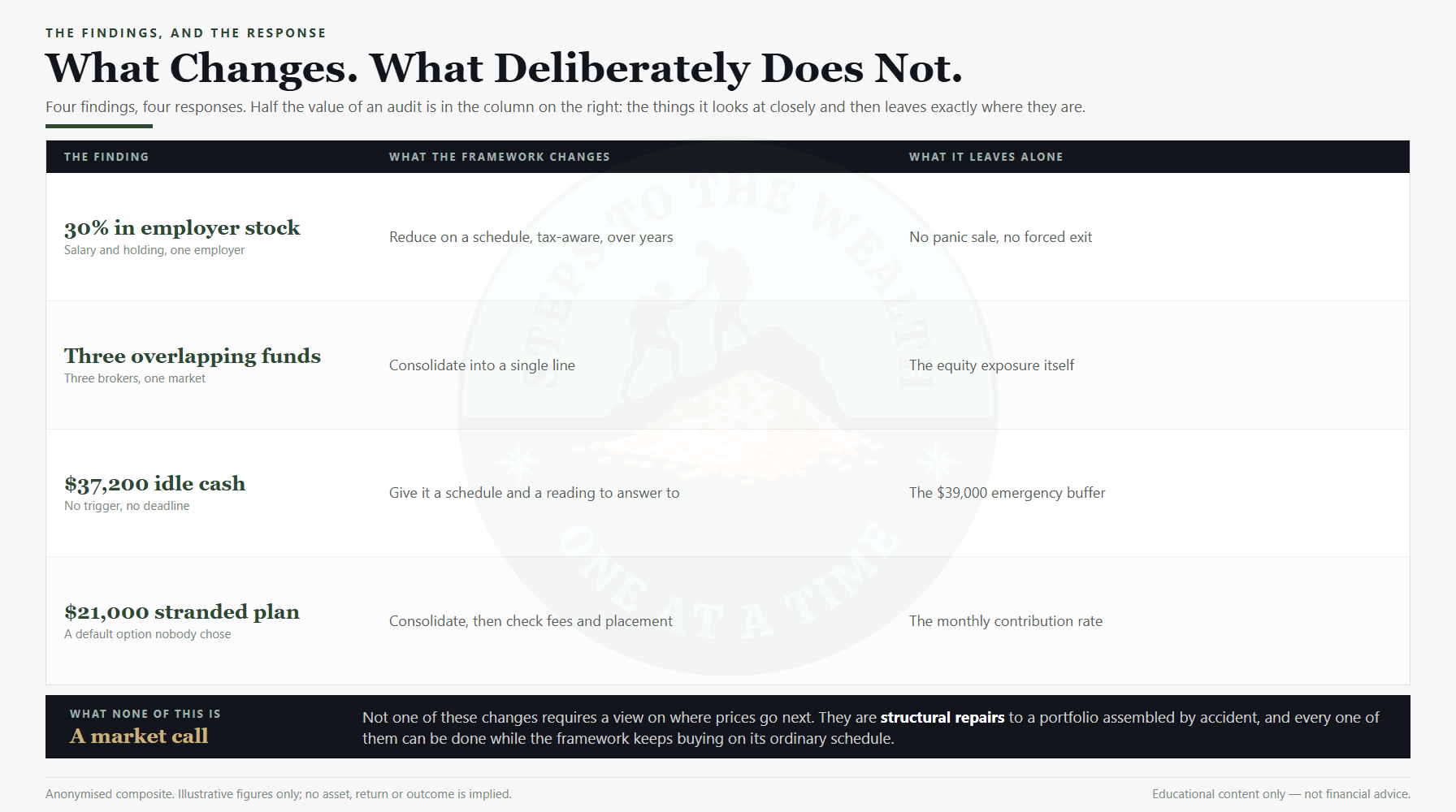
The accidental concentration gets named as the portfolio’s central risk: large by inertia, doubly exposed through the reader’s income, and a candidate for gradual, tax-aware reduction over years rather than a panic sale. The fake diversification gets consolidated into a single line, without changing the equity exposure itself, and the portfolio’s total absence of any second driver gets written down as a finding rather than left as a feeling.
The cash gets sorted into buckets that each have a job. Buffer walled off at $39,000 and never touched, near-term money set aside, and the remaining $37,200 put on a deployment schedule that answers to a reading instead of a mood. The orphaned account gets consolidated, its fees and default fund checked, and the whole portfolio organised by account type so that placement stops being an accident of which account was open at the time.
What the audit refuses to produce is a list of things to buy. Anyone who answers “is my portfolio any good?” with a shopping list is selling something, and the delay dressed up as diligence is its own cost: what you lose by postponing a structural fix for a year is the same arithmetic as the opportunity cost of time applied to your own inaction.
Underneath all of it, the portfolio stops being an archaeology of past moods and becomes something a system maintains. Most of the ongoing work, once the cleanup is done, is holding the shape on the weeks the framework says hold, which is most weeks.
How to run this portfolio audit on your own holdings
You do not need me for this. The four questions are the audit, and they take an afternoon with your actual statements open in front of you.
One: is my biggest position my highest-conviction holding, or just where money accumulated? If I were building it from cash today, would I size it this way? Two: am I diversified across drivers, or do I own many things that respond to the same force? Three: is my cash a sized position with a trigger, or undeployed money waiting for a feeling? Four: what is the structure costing me in fees, stranded accounts and tax-inefficient placement?
Write the answers down. Almost everyone finds at least one accidental concentration, at least one piece of fake diversification and at least one orphaned account, because almost everyone assembled their portfolio the same way this reader did. Finding all three does not mean you have been careless. It means nothing was setting the weights, and now something is.
What a portfolio audit cannot tell you
An audit fixes structure. It does not tell you whether you will do well, and it is worth being precise about why.
The largest variable left after the structural work is behaviour, and it is measurable. Barber and Odean’s study of 66,465 households from 1991 to 1996 found the market returned 17.9% a year while the average household earned 16.4% and the busiest fifth of traders earned 11.4%. That is a gap of 1.5 points for the average household and 6.5 points for the most active, produced entirely by what people did to their own portfolios. The original paper is free to read, and it remains the cleanest evidence that activity and outcome move in opposite directions.
Which failure mode you are prone to is worth knowing before you start making changes, and Morningstar’s four behavioural investor types is a reasonable map of the common ones. An audit cannot install temperament. It can only remove the structural excuses that make bad temperament expensive.
Two other things sit outside its scope. An audit cannot tell you whether your position is normal for someone in your circumstances, which is a comparison question and answered separately by benchmarking against your own band rather than against the loudest people online. And it cannot audit a household. If two people are running one balance sheet with two different risk tolerances, the portfolio is downstream of that conversation, not upstream of it, and financial compatibility is not a score covers why that conversation resists being reduced to a number.
What it can do, once the structure is clean, is tell you whether the plan you are running still reaches the thing you are running it for. That is a separate measurement, and the plan gap exists to make it explicit rather than assumed.
One more limit, on frequency. An audit is a structural exercise, not a monitoring habit, and running it monthly converts it into exactly the activity Barber and Odean measured the cost of. Once a year is enough, plus whenever the structure genuinely changes: a job move, a vesting cliff, a house, a new dependant, a divorce. Between those dates the correct number of audits is zero, and the correct amount of portfolio attention is whatever the schedule already asks for.
Run the audit. Then let the system maintain what the audit cleaned up, and spend the attention you were spending on the portfolio on the part that actually pays: the contributions, the schedule, and not interfering.
If you want the weekly reading and the reasoning behind it, that is what the newsletter is for.
Educational content only. Not financial advice. The portfolio described here is an anonymised composite, illustrative in every figure, and is not a recommendation to buy, sell or hold any asset. Concentration, tax and account decisions depend on individual circumstances; work with a qualified professional before acting.